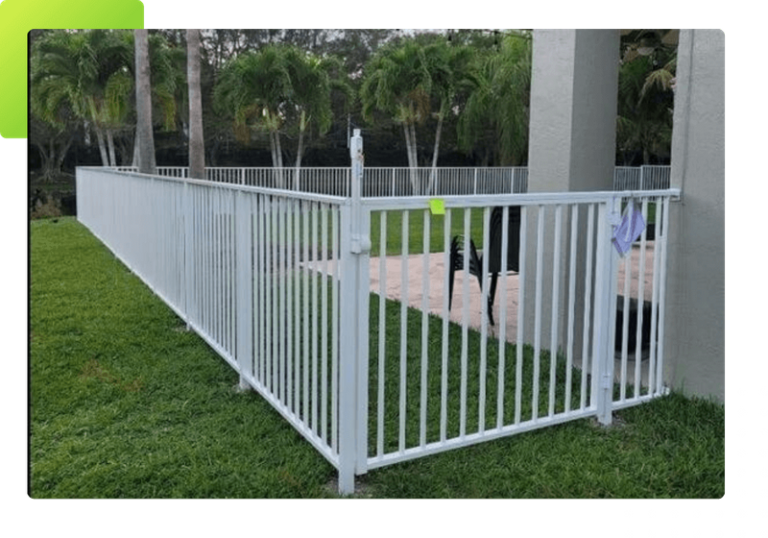
If your property is in a high-velocity hurricane zone (HVHZ) in South Florida, your fence material likely needs to carry a Miami-Dade Notice of Acceptance (NOA) or equivalent product approval. This guide explains what NOA means, which fence products carry it, and why this matters for your project, your code compliance, and your insurance.
What is a Miami-Dade NOA?
The Notice of Acceptance is issued by the Miami-Dade County Product Control Division and certifies that a building product has been tested and approved to perform under hurricane wind loads. Products with a Miami-Dade NOA are accepted across all HVHZ counties in Florida and many non-HVHZ jurisdictions as well.
The NOA system was created after Hurricane Andrew in 1992 to ensure building products perform under real hurricane conditions, not just the manufacturer’s marketing claims. NOA approval involves wind tunnel testing, impact testing, and engineering review.
What is the HVHZ?
The high-velocity hurricane zone covers Miami-Dade and Broward counties, plus eastern parts of Palm Beach County (typically east of I-95). Properties in the HVHZ require building products rated for sustained winds of 175 mph or higher.
For fences specifically, HVHZ requirements typically include:
- Fence components rated by NOA or equivalent wind testing
- Reinforced posts with deeper concrete footings (commonly 36 inches versus standard 24)
- Upgraded fasteners and hardware
- Specific spacing and bracing requirements per the NOA document
Which Fence Materials Have NOA Approval?
Vinyl Fences
Major vinyl fence manufacturers (Bufftech, ActiveYards, CertainTeed, and others) offer specific product lines with Miami-Dade NOA approval. These are typically heavy-gauge profiles with thicker walls than standard vinyl, reinforced internal aluminum support in posts, and specific installation specs. Look for NOA numbers in the manufacturer documentation before purchase.
Aluminum Fences
Most premium aluminum fence manufacturers carry NOA approval for their picket lines. Installation specs require specific post depth, footing dimensions, and fastener types. Standard aluminum from a big-box store typically does not carry NOA approval.
Wood Fences
Wood fences do not have NOA approval as such, but local jurisdictions accept pressure-treated wood when installed to engineered specifications meeting the HVHZ wind load requirements. Wood fences in HVHZ require deeper post footings (commonly 36 inches), thicker posts (commonly 4×6 instead of 4×4 for fences over 5 feet), and reinforced connections.
Chain Link Fences
Chain link is the most hurricane-tolerant fence material because the open weave lets wind pass through rather than acting as a sail. NOA approval for chain link is uncommon (and unnecessary) because the wind load on chain link is naturally low. Standard installation meets code in most HVHZ jurisdictions.
How HVHZ Affects Your Fence Cost
HVHZ specs typically add 8 to 15 percent to the total fence cost:
- Heavy-gauge NOA-approved vinyl runs about $5 to $10 more per linear foot than standard vinyl
- Reinforced post footings add about $3 to $6 per linear foot in deeper concrete
- NOA-approved aluminum runs about $4 to $8 more per linear foot
- Engineered wood post designs add about $4 to $7 per linear foot
The premium is real but pays off the first time a major storm comes through. We have repaired far more non-HVHZ-rated fences after hurricanes than we have lost code-compliant ones. If your fence already has storm damage, our fence repair service can help, including fences we didn’t install.
How NOA Compliance Gets Verified
During the building permit process, the city Building Division reviewer checks:
- Manufacturer specification sheet shows valid current NOA number
- Installation details (post depth, fastener spec, footing dimensions) match the NOA requirements
- Wind load calculations support the design wind speed for the property’s zone
NOA numbers expire and get renewed; the spec sheet must show a current NOA at the time of permit application. We verify NOA validity for every HVHZ quote.
Common HVHZ Permit Issues
Expired NOA
NOAs have expiration dates. A manufacturer spec sheet showing an expired NOA gets the permit rejected. Always check the current NOA status with the manufacturer at quote time.
Installation Spec Mismatch
The NOA approval specifies exact installation requirements (post depth, footing size, fastener type). Deviating from these voids the NOA approval. The Building Division reviewer compares your submission to the NOA spec exactly.
Wind Zone Misidentification
Properties near the HVHZ boundary sometimes get misidentified. The wind zone classification for your specific address is in the local building department records and can be verified with a wind zone map call.
Does Your Property Need NOA-Rated Fencing?
If you are unsure, the simplest test:
- Property in Miami-Dade County: yes
- Property east of I-95 in Broward County: almost certainly yes
- Property east of I-95 in Palm Beach County: yes for most addresses; varies by neighborhood west of I-95
- Property in Monroe County (Keys): yes, with even stricter wind speed requirements
We confirm wind zone classification as part of every quote for any address that might be in the HVHZ.
Frequently Asked Questions
Will my insurance pay out if my non-HVHZ-rated fence fails in a hurricane?
If your property is in the HVHZ and the fence did not meet the wind requirement, the insurance company can deny the claim. Even outside HVHZ, insurers often deny claims for fences that did not meet local code at the time of installation.
How do I know if a vinyl fence I’m being quoted carries NOA approval?
Ask the contractor for the manufacturer specification sheet with the NOA number visible. Cross-reference the NOA number at Miami-Dade County’s product control database (miamidade.gov) to verify it is current and applies to the specific product profile being installed.
What about properties in unincorporated Broward or Palm Beach County?
Unincorporated parts of these counties fall under the county building department, which generally enforces HVHZ for the same geographic areas as the incorporated cities. The NOA requirement applies based on wind zone, not municipal boundary.
Can a fence be NOA-approved retroactively?
No. The product itself has to carry an NOA from the manufacturer. A fence installed without NOA-approved components cannot be retroactively certified.
Get HVHZ-Compliant Fencing Installed
Xtreme Fence installs NOA-approved vinyl and aluminum across South Florida HVHZ markets. Contact us or call (954) 851-6610.
Related: